Focus · UAE Digital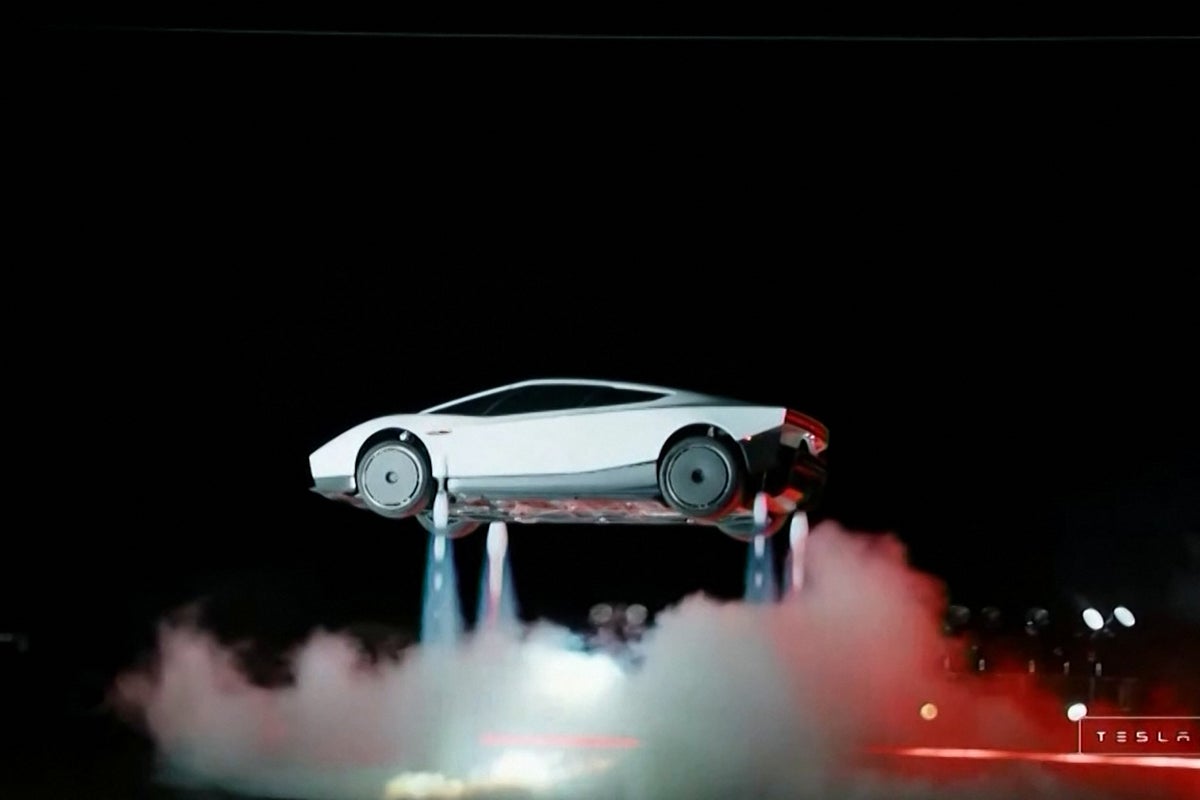
E lon Musk has often been compared to Henry Ford , the 20th-century industrialist and titan of the automotive industry. But this week the South African entrepreneur, who runs SpaceX and X alongside his electric vehicle firm, Tesla , appeared to do something Ford never could. In 1940, Ford made a prediction that sounded pretty outlandish, even for a man who had helped revolutionise how we travel through the mass production of cars.
“Mark my words,” he said , “a combination airplane and motor car is coming. You may smile. But it will come.” It took 86 years, and Elon Musk , to seemingly do so.
The enigmatic entrepreneur unveiled a new version of Tesla’s long-awaited Roadster , an electric sports car that can accelerate from 0 to 60mph in a claimed 0.81 seconds, drive upside down and even propel itself through the air using technology developed by his rocket company, SpaceX. Real deal or hot air? The new Tesla uses compressed blasts to glide through the air (Tesla) At a demonstration at SpaceX’s testing facility in Texas , the car performed aerial flips and jumped over a line of other Tesla vehicles, before returning to the ground.
It's an impressive feat of engineering, and one that Musk has spent years promising would become a reality. It’s also the latest in a long history of trying to combine the best road-borne vehicles with the ability to take flight. In 1949, American inventor Moulton Taylor’s Aerocar had its first flight.
It was a vehicle that could be driven on ordinary roads before having wings attached, thus turning it into an aircraft. It even received official aviation certification in 1956, but only six were ever built because costs (and risks) were too high. Today, California firm Alef Aeronautics got limited permission from American aviation regulators to test its own flying car in 2023, and showed off a prototype that could take off and land vertically.
Musk has not always been enthusiastic about flying cars. At a TED conference in 2017, he warned that they could be noisy and frightening, with poorly maintained parts falling from above. He joked that a loose hubcap might chop the head off someone walking beneath it.
Now he seems to have changed his mind. Me and Jane in a car: the Aerocar made its first flight in 1949 (Corbis/Getty) “Getting a car off the ground and back down again in a stable way takes good engineering. But we should be clear about what it was: a stunt,” says Michael Thompson, CEO of Skyfly, a UK-based aerospace company.
“None of the technology involved is new or novel, and it doesn’t move us any closer to practical flying cars.” The reason we haven’t yet got our flying cars is quite simple: cars and aircraft look and act very differently, and they’re not a combination that merges well. Cars have to be strong enough to withstand the poor state of pothole-pocked roads, as well as be safe in collisions, while aircraft need to be as light as possible to stay airborne with the minimum possible energy usage. Compromising on one or the other requires difficult decisions.
Getting a car off the ground and back down again in a stable way takes good engineering. But we should be clear about what it was: a stunt One obstacle is energy. Electric motors have plenty of oomph, but batteries are heavy for the energy they store, reducing how far a passenger-carrying aircraft can fly.
European aviation regulator EASA has singled out battery energy density as a major hurdle for electric aviation. Other companies are approaching the dream from the opposite direction: building aircraft that take off vertically, rather than making cars fly. Britain’s Vertical Aerospace demonstrated piloted flights at Farnborough in July, with electric aircraft switching between hovering and wing-borne flight.
But certification and paying passengers are still some way off. Elon Musk has made negative comments about flying cars before – but his new announcement shows he is more than interested in the concept (AFP/Getty) Simon Davies, chief test pilot at Vertical Aerospace, has his eye on “how reliably it can repeat that performance and how it responds if something goes wrong”. The company is targeting certification of its Valo passenger aircraft in 2029.
“It takes time because every claim about the aircraft’s safety has to be backed by evidence,” Davies says. Regulation is another obstacle. A UK Civil Aviation Authority spokesperson says anyone selling a personal flying car must “demonstrate that it meets the relevant safety, equipment and operational standards expected of aircraft that are operated privately”.
The driver or pilot must also be “suitably qualified to operate the aircraft within the intended airspace”. Skyfly’s Thompson points out that cold-gas thrusters work for short bursts of precise control, not sustained flight. “You can only carry so much compressed gas, so flight time is measured in seconds,” he says.
“And once the gas runs out, there is nothing to keep you in the air.” This is ‘Charlie and the Chocolate Factory’ stuff that will never see the light of day Matthias Schmidt, independent automotive analyst The Roadster isn’t yet available to buy, and it’s not clear whether some of the most impressive technical elements that have garnered the headlines would actually end up in a roadworthy vehicle, even if Tesla manages to meet its production plan of vehicles rolling out of factories in 2028. Because of all that, some are highly sceptical about whether we’re actually seeing a Jetsons-like future of flying cars. “This is Charlie and the Chocolate Factory stuff that will never see the light of day,” says independent automotive analyst Matthias Schmidt.
“Elon and the fantasy factory appears from the periphery as little more than a vanity project, something top patriarchs have never shied away from, whether in politics or industry.” Schmidt reckons the stunt could still succeed as marketing. “The fact that we are even talking about it means those investments can be siphoned from the marketing budget,” he said. And in that way, it’s a success, Schmidt points out.
The unveiling of the vehicle was a coup de theatre of the type typical of the Tesla chief executive. “Elon Musk is anything but ordinary,” says Cary Cooper, professor of organisational psychology at Manchester Business School, who has studied Musk’s career as he’s propelled himself into the limelight. The Tesla Roadster uses SpaceX rockets to make it fly (Tesla) The Roadster prototype was extraordinary, though far from road-ready.
And yet, Musk has a history of making big, bold swings that sound laughable, but turn into a reality. SpaceX has developed rockets capable of landing themselves for reuse, something that would once have sounded like science fiction. In October 2024, it went a step further by catching a returning Starship booster using enormous mechanical arms attached to its launch tower.
And Tesla helped turn electric cars from relatively niche products into mainstream alternatives to petrol-powered vehicles – while also popularising early-stage self-driving software. But those big swings can take much longer to land than Musk predicts. In 2019, he said Tesla would have over a million robotaxis by 2020; the company only launched a limited service in Austin in 2025.
Its Optimus humanoid robot remains a work in progress , with Musk warning this year that production would initially be “agonisingly slow”. The Roadster itself was unveiled in 2017, with deliveries originally promised for 2020. “His flying car may ultimately, in one form or another, be an everyday occurrence as was Tesla, SpaceX, and others,” says Cooper.
“Regardless of his voyage into political issues, he is a true entrepreneur with novel products that stimulate new and varied innovations.”
Source: The Independent